
Table of Contents
- Understanding Business Continuity
- Why Information Is the Lifeblood of Modern Organizations
- The Hidden Cost of Poor Information Management
- Accessibility Is Essential for Continuity
- The Role of Accurate Information
- Data Loss Can Disrupt Operations Instantly
- Supporting Faster Decision-Making
- Information Security and Business Continuity
- The Importance of Centralized Information Management
- Employee Turnover and Knowledge Retention
- Regulatory Compliance and Information Governance
- Building Resilience Through Information Management
- Practical Steps to Improve Information Management
- Centralize Information
- Improve Access Controls
- Maintain Data Accuracy
- Implement Backup Strategies
- Train Employees
- The Future of Information Management
- Frequently Asked Questions
- What is information management?
- Why is information management important for business continuity?
- How does poor information management affect organizations?
- What are the biggest risks to business information?
- How can organizations improve information management?
- Conclusion
In today's digital economy, information has become one of the most valuable assets any organization owns. Whether it is customer records, financial documents, employee data, contracts, operational reports, project files, or business communications, organizations depend on information every single day to make decisions, serve customers, manage operations, and drive growth.
While many business leaders focus on revenue, customer acquisition, technology investments, and market expansion, one critical factor often receives less attention than it deserves: information management.
The reality is simple. Every business process depends on information. Employees need access to accurate data to complete tasks. Managers require reliable information to make decisions. Customers expect organizations to respond quickly and efficiently. When information becomes inaccessible, outdated, incomplete, or lost, business operations can quickly slow down or even stop entirely.
This is why information management plays such an important role in business continuity.
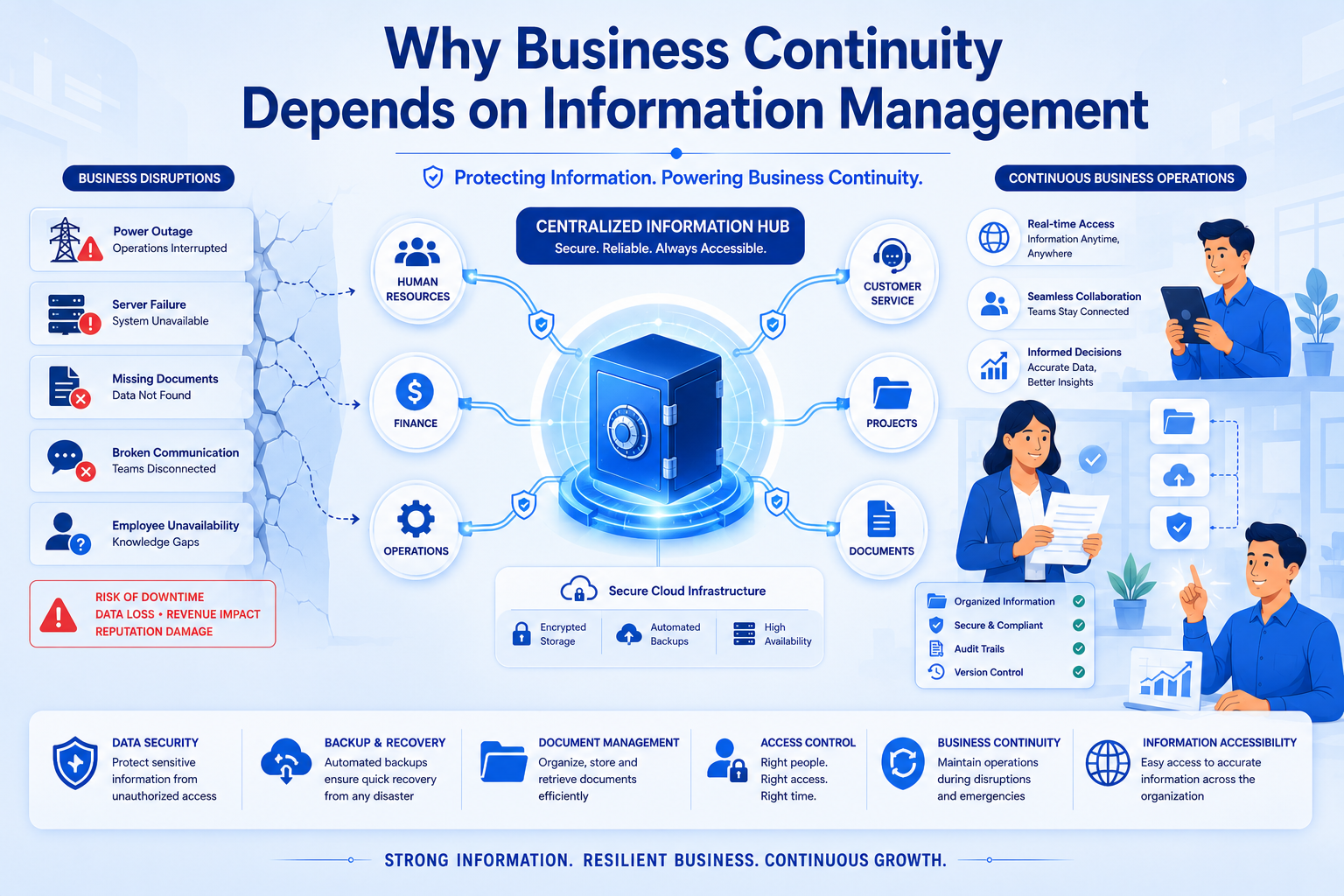
Business continuity refers to an organization's ability to continue operating during disruptions, unexpected events, system failures, cyberattacks, natural disasters, employee turnover, or other challenges. While organizations often focus on physical infrastructure and technology when planning for continuity, information is the foundation that supports every aspect of operations.
Without access to the right information at the right time, even the most advanced organizations can struggle to function effectively.
As workplaces become increasingly digital and data-driven, strong information management practices are no longer optional. They are essential for maintaining operational resilience, protecting business assets, and ensuring long-term success.
Understanding Business Continuity
Business continuity is often misunderstood as simply having a backup plan for emergencies.
In reality, business continuity is much broader.
It involves ensuring that critical business activities can continue with minimal disruption regardless of what challenges arise.
Organizations face numerous risks every day, including:
- System failures
- Cybersecurity incidents
- Human errors
- Hardware breakdowns
- Data loss
- Unexpected employee departures
While these risks may vary in severity, they all have one thing in common: they can disrupt access to information.
When information becomes unavailable, operations can quickly come to a standstill.
Employees may be unable to access documents. Customer requests may go unanswered. Financial transactions may be delayed. Projects may be interrupted.
Business continuity depends on the ability to maintain access to critical information even during challenging circumstances.
Why Information Is the Lifeblood of Modern Organizations
Every organization relies on information to function.
Departments across the business use information in different ways.
Human Resources manages employee records and payroll information.
Finance teams rely on invoices, budgets, and financial reports.
Sales departments maintain customer information and contract details.
Operations teams use project documentation, inventory records, and workflow data.
Without access to this information, routine tasks become difficult or impossible.
Unlike physical assets, information is used simultaneously by multiple people throughout the organization.
Its value increases when it is accessible, accurate, and well-managed.
Organizations that understand this relationship are often better prepared to respond to disruptions and maintain continuity.
The Hidden Cost of Poor Information Management
Many organizations underestimate the impact of poor information management.
At first, the consequences may seem minor.
Employees spend extra time searching for files.
Reports take longer to generate.
Information becomes duplicated across multiple systems.
However, these small inefficiencies can gradually create larger operational problems.
Some common consequences include:
- Delayed decision-making
- Reduced productivity
- Increased operational risk
When information is difficult to locate, employees waste valuable time searching instead of working.
When data is inconsistent, managers struggle to make informed decisions.
When critical documents are lost or inaccessible, customer service suffers.
Poor information management often creates hidden costs that affect the entire organization.
Accessibility Is Essential for Continuity
One of the most important aspects of information management is accessibility.
Information must be available when employees need it.
This does not mean providing unrestricted access to everyone.
Instead, it means ensuring that authorized individuals can quickly locate and use the information necessary for their responsibilities.
Organizations frequently encounter challenges such as:
- Files stored in multiple locations
- Outdated document versions
- Limited visibility across departments
These issues can slow operations and create unnecessary confusion.
Effective information management ensures that employees have access to accurate information whenever they need it.
This accessibility becomes particularly important during emergencies and unexpected disruptions.
The Role of Accurate Information
Access to information is important, but accuracy is equally critical.
Organizations make decisions based on the information available to them.
If that information is incorrect, incomplete, or outdated, the resulting decisions may create additional problems.
Examples include:
- Inaccurate financial reporting
- Incorrect inventory levels
- Outdated employee records
Even small inaccuracies can have significant consequences.
Maintaining accurate information requires consistent processes, regular updates, and strong data governance practices.
Organizations that prioritize information accuracy are often more agile and resilient.
Data Loss Can Disrupt Operations Instantly
One of the greatest threats to business continuity is data loss.
Information can be lost for many reasons, including:
- Hardware failures
- Human mistakes
- Cyberattacks
- Accidental deletions
Without proper safeguards, recovering lost information can be difficult or impossible.
The consequences of data loss extend beyond operational disruption.
Organizations may face:
- Financial losses
- Regulatory penalties
- Reputational damage
Protecting information through backups, version control, and secure storage is essential for maintaining continuity.
A strong information management strategy helps reduce the risk of permanent data loss.
Supporting Faster Decision-Making
Business leaders rely on information to make strategic decisions.
When information is fragmented, outdated, or difficult to access, decision-making becomes slower and less effective.
Managers may spend significant time gathering information from multiple sources before reaching conclusions.
This delay can impact competitiveness and responsiveness.
Organizations that manage information effectively often benefit from:
- Faster reporting
- Better visibility
- Improved forecasting
Access to reliable information helps leaders make informed decisions with greater confidence.
Information Security and Business Continuity
Security plays a major role in information management.
Organizations must protect sensitive information from unauthorized access while ensuring it remains available to authorized users.
Cybersecurity threats continue to increase across industries.
Attackers frequently target:
- Customer records
- Financial data
- Employee information
A security breach can disrupt operations, damage trust, and create long-term consequences.
Strong information management practices help organizations balance security and accessibility.
This balance is essential for maintaining business continuity.
The Importance of Centralized Information Management
Many organizations struggle because information is scattered across multiple systems.
Documents may be stored on personal computers, shared drives, email attachments, and external devices.
This fragmentation creates inefficiencies and increases risk.
Centralized information management helps organizations:
- Improve accessibility
- Reduce duplication
- Strengthen security
A centralized approach ensures that employees work from consistent information sources.
It also improves visibility and simplifies administrative oversight.
Organizations with centralized information systems are often better prepared to manage disruptions.
Employee Turnover and Knowledge Retention
Employee turnover is a normal part of business operations.
However, organizations often underestimate the amount of knowledge employees possess.
When key employees leave, valuable information may leave with them.
Without proper information management, organizations may struggle to recover critical knowledge.
Documented processes, centralized records, and structured information systems help preserve organizational knowledge.
This continuity reduces disruption during staffing changes and supports long-term stability.
Regulatory Compliance and Information Governance
Many industries operate under strict regulatory requirements.
Organizations must maintain accurate records and demonstrate responsible information management practices.
Compliance requirements often involve:
- Data protection
- Record retention
- Audit readiness
Failure to manage information properly can create compliance risks and legal challenges.
Strong information governance helps organizations meet regulatory expectations while improving operational consistency.
Building Resilience Through Information Management
Business resilience depends on preparation.
Organizations cannot predict every disruption, but they can prepare for many potential challenges.
Effective information management contributes to resilience by ensuring:
- Information remains accessible
- Data remains protected
- Processes remain consistent
When disruptions occur, organizations with strong information management practices are often able to recover more quickly.
Resilience is not just about technology.
It is about ensuring that people have the information they need to continue operating effectively.
Practical Steps to Improve Information Management
Organizations looking to strengthen business continuity should focus on several key areas.
Centralize Information
Reduce fragmentation by storing information in secure, organized systems.
Improve Access Controls
Ensure employees can access the information they need while protecting sensitive data.
Maintain Data Accuracy
Regularly review and update information.
Implement Backup Strategies
Protect critical information through reliable backup and recovery processes.
Train Employees
Ensure staff understand information management policies and responsibilities.
Small improvements in these areas can significantly strengthen business continuity.
The Future of Information Management
As organizations continue adopting digital technologies, information management will become even more important.
Emerging technologies such as automation, artificial intelligence, and advanced analytics rely heavily on accurate and accessible information.
Organizations that invest in information management today will be better positioned to:
- Improve efficiency
- Support innovation
- Manage risk
The ability to organize, protect, and utilize information effectively will remain a critical competitive advantage.
Frequently Asked Questions
What is information management?
Information management involves organizing, storing, protecting, and providing access to business information.
Why is information management important for business continuity?
It ensures critical information remains accessible and protected during disruptions.
How does poor information management affect organizations?
It can lead to delays, productivity loss, inaccurate decisions, security risks, and operational disruptions.
What are the biggest risks to business information?
Common risks include cyberattacks, data loss, human errors, hardware failures, and poor record management.
How can organizations improve information management?
Organizations can centralize information, improve security, maintain data accuracy, and implement reliable backup processes.
Conclusion
Business continuity is about more than surviving disruptions. It is about ensuring that organizations can continue operating, serving customers, supporting employees, and achieving objectives regardless of unexpected challenges.
At the heart of this capability lies information management.
Information drives every business process, supports every decision, and connects every department. When information is organized, accessible, accurate, and secure, organizations become more resilient and better prepared for the future.
As the business world becomes increasingly digital, effective information management is no longer just an operational requirement—it is a strategic necessity.
Organizations that prioritize information management today are building the foundation for stronger business continuity, greater operational stability, and long-term success tomorrow.