Table of Contents
- Understanding the Productivity Gap
- The Hidden Impact of Meetings
- Communication Delays and Information Gaps
- The Cost of Administrative Work
- Searching for Information
- Approval Bottlenecks
- Context Switching and Lost Focus
- The Role of Workplace Technology
- Employee Burnout and Productivity
- How Organizations Can Close the Productivity Gap
- Improve Communication
- Streamline Workflows
- Reduce Unnecessary Meetings
- Improve Information Access
- Automate Repetitive Tasks
- Why Workplace Efficiency Matters
- The Future of Productivity
- Frequently Asked Questions
- What is the productivity gap?
- What causes productivity loss in organizations?
- How do meetings affect productivity?
- Why is workflow optimization important?
- How can organizations improve workplace productivity?
- Conclusion
- Explore Smarter Workplace Solutions
In every organization, productivity is one of the most discussed topics. Managers want teams to perform efficiently, employees want to accomplish meaningful work, and business leaders continuously look for ways to improve output without increasing costs. Yet despite investments in technology, training, and workplace improvements, many organizations still struggle with a hidden challenge known as the productivity gap.
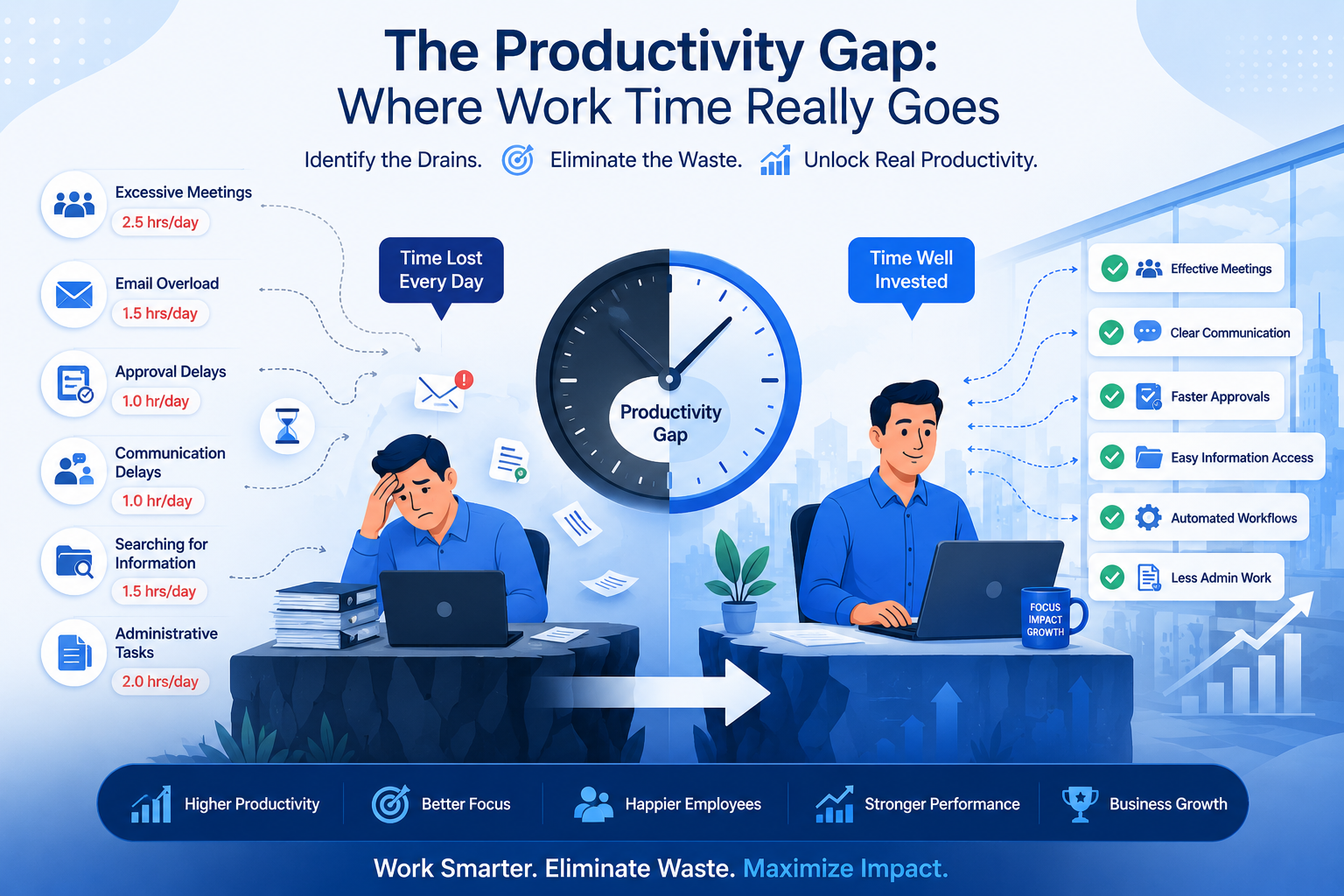
The productivity gap refers to the difference between the amount of work employees could accomplish and the amount they actually accomplish during a typical workday. Surprisingly, this gap is rarely caused by a lack of effort. Most employees are busy throughout the day. They attend meetings, respond to emails, complete administrative tasks, follow up on requests, search for information, and participate in various workplace activities.
The problem is that being busy does not always mean being productive.
Many employees spend a significant portion of their workday on activities that contribute little to their primary responsibilities. These hidden time drains accumulate gradually, reducing efficiency and making it difficult for teams to focus on high-value work.
As organizations continue to adapt to modern workplace demands, understanding where work time really goes has become essential. By identifying common productivity barriers, businesses can improve workplace efficiency, support employees more effectively, and create an environment where meaningful work receives the attention it deserves.
Understanding the Productivity Gap
The productivity gap is not necessarily the result of poor performance. In fact, many highly motivated employees experience productivity challenges because their work environments contain obstacles that slow progress.
Employees often begin the day with clear priorities and goals. However, as the day unfolds, they encounter interruptions, meetings, approval requests, communication delays, and administrative responsibilities that compete for their attention.
By the end of the day, they may feel busy and exhausted while making less progress than expected.
This experience is common across industries.
The issue is not that employees are unwilling to work. The issue is that many organizations unknowingly create conditions that make productive work more difficult.
Understanding these conditions is the first step toward improving productivity.
The Hidden Impact of Meetings
Meetings play an important role in workplace collaboration. They help teams share information, align priorities, and solve problems together.
However, meetings can also become one of the biggest productivity drains in an organization.
Many employees spend several hours each week attending meetings that provide limited value. In some cases, participants attend simply because they were invited rather than because their involvement is necessary.
Long meetings, unclear agendas, and excessive discussions often consume valuable working hours.
Some common meeting-related productivity challenges include:
- Meetings without clear objectives
- Too many participants
- Discussions that could be handled through simple communication
When meetings become excessive, employees have less time available for focused work.
Organizations that evaluate the effectiveness of their meetings often discover significant opportunities to improve productivity.
Communication Delays and Information Gaps
Communication is essential for workplace success, but poor communication can create substantial productivity challenges.
Employees frequently depend on information from colleagues, managers, vendors, and clients before they can move forward with tasks.
When communication is delayed, work often comes to a standstill.
Examples include waiting for:
- Project updates
- Approval decisions
- Clarification on requirements
These delays may seem minor individually, but they can quickly accumulate throughout the organization.
Information gaps also create confusion. Employees may spend additional time searching for answers, confirming details, or correcting misunderstandings.
Effective communication systems help reduce delays and improve overall workflow efficiency.
The Cost of Administrative Work
Administrative tasks are necessary for business operations, but they can consume a surprising amount of employee time.
Activities such as:
- Updating spreadsheets
- Entering data
- Filing documents
- Managing approvals
often require considerable effort.
While these responsibilities are important, they may prevent employees from focusing on more strategic work.
Many organizations underestimate the impact of administrative workload.
When employees spend large portions of their day managing routine tasks, productivity suffers.
Reducing unnecessary administrative work is one of the most effective ways to improve workplace efficiency.
Searching for Information
One of the most overlooked productivity challenges is the amount of time employees spend searching for information.
Every day, employees look for:
- Documents
- Reports
- Emails
- Contracts
- Project files
In organizations where information is scattered across multiple systems, finding the right file can become surprisingly difficult.
Employees may spend several minutes—or even hours—searching for information they need to complete their work.
This lost time rarely appears on productivity reports, but its impact can be substantial.
Improving information management and accessibility helps employees spend less time searching and more time producing results.
Approval Bottlenecks
Approvals are designed to ensure accuracy, accountability, and compliance.
However, approval processes can become major productivity barriers when they involve unnecessary complexity.
Employees often find themselves waiting for:
- Expense approvals
- Leave requests
- Purchase authorizations
- Project sign-offs
While waiting, progress may stop completely.
Multiple approval layers can create delays that affect entire teams.
Organizations that streamline approval workflows often experience faster decision-making and improved productivity.
Context Switching and Lost Focus
Modern employees frequently switch between tasks throughout the day.
An employee may begin working on a report, respond to an email, join a meeting, answer a phone call, and then return to the report.
Each interruption requires the brain to refocus.
This process, known as context switching, reduces concentration and increases mental fatigue.
Even brief interruptions can disrupt momentum and make it more difficult to complete complex tasks efficiently.
Creating opportunities for focused work can significantly improve productivity.
Employees often perform their best work when they have uninterrupted time to concentrate on important responsibilities.
The Role of Workplace Technology
Technology has transformed the way organizations operate.
When implemented effectively, technology can improve:
- Communication
- Collaboration
- Information access
However, technology can also contribute to productivity challenges if systems are poorly integrated or difficult to use.
Employees may spend unnecessary time navigating multiple platforms, entering duplicate information, or managing disconnected workflows.
The goal of workplace technology should be to simplify work rather than complicate it.
Organizations that align technology with employee needs often achieve stronger productivity outcomes.
Employee Burnout and Productivity
Productivity is closely connected to employee well-being.
Employees who experience excessive stress, constant interruptions, and overwhelming workloads often struggle to maintain high performance.
Burnout can lead to:
- Reduced engagement
- Lower motivation
- Increased errors
Organizations that prioritize employee well-being often see improvements in both productivity and retention.
Supporting employees through realistic workloads, clear expectations, and healthy work environments benefits both individuals and organizations.
How Organizations Can Close the Productivity Gap
Closing the productivity gap requires a thoughtful approach.
Organizations should begin by identifying the activities that consume the most time and evaluating whether those activities contribute meaningful value.
Several strategies can help improve productivity:
Improve Communication
Clear and timely communication reduces delays and misunderstandings.
Streamline Workflows
Simplifying processes helps employees complete tasks more efficiently.
Reduce Unnecessary Meetings
Only schedule meetings when collaboration is genuinely required.
Improve Information Access
Employees should be able to find important information quickly.
Automate Repetitive Tasks
Automation helps reduce administrative workload and improves efficiency.
Small improvements across these areas can create significant productivity gains.
Why Workplace Efficiency Matters
Productivity is not about working longer hours.
It is about using available time effectively.
Organizations that improve workplace efficiency often experience:
- Faster project completion
- Better employee satisfaction
- Stronger operational performance
When employees spend more time on meaningful work and less time on unnecessary activities, everyone benefits.
Improved efficiency creates a more positive work environment while supporting organizational growth.
The Future of Productivity
As workplaces continue evolving, productivity will remain a key priority.
Organizations are increasingly focusing on:
- Workflow optimization
- Employee experience
- Digital transformation
The future workplace will emphasize smarter ways of working rather than simply working harder.
Technology, collaboration, and process improvements will continue shaping how employees manage their time and responsibilities.
Organizations that embrace these changes will be better positioned to succeed in a competitive environment.
Frequently Asked Questions
What is the productivity gap?
The productivity gap is the difference between the amount of work employees could accomplish and the amount they actually complete due to workplace obstacles and inefficiencies.
What causes productivity loss in organizations?
Common causes include excessive meetings, communication delays, administrative tasks, approval bottlenecks, and difficulty accessing information.
How do meetings affect productivity?
Meetings consume valuable work time and can reduce focus when they are unnecessary or poorly managed.
Why is workflow optimization important?
Workflow optimization helps reduce delays, improve efficiency, and support better employee performance.
How can organizations improve workplace productivity?
Organizations can improve productivity through better communication, streamlined processes, improved information access, and automation.
Conclusion
The productivity gap is not always visible, but its effects can be felt throughout an organization. Employees lose valuable time every day through meetings, approval delays, administrative work, communication gaps, and information challenges.
By understanding where work time really goes, organizations can identify opportunities for improvement and create environments that support focused, meaningful work.
Productivity is not about asking employees to do more. It is about removing the barriers that prevent them from doing their best work.
Organizations that successfully close the productivity gap often experience stronger employee engagement, improved workplace efficiency, and better long-term results.
Explore Smarter Workplace Solutions
Looking for ways to improve workplace efficiency, streamline workflows, and reduce productivity bottlenecks?
Discover digital solutions designed to help teams communicate better, manage information effectively, and work more efficiently.
Explore More: https://i-spur.com/recruitment-portal